

The Law of Cryonics
A Legal Philosophical and Financial Analysis
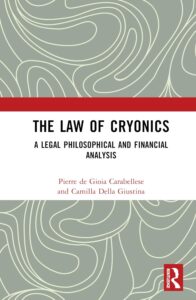
The Law of Cryonics: A Legal Philosophical and Financial Analysis
By Pierre de Gioia Carabellese and Camilla Della Giustina
Routledge, 2024
Hardback, £135, ISBN 9781032557908
A Cryonics Society Review
Pierre de Gioia Carabellese and Camilla Della Giustina’s The Law of Cryonics arrives at an appropriate moment, when cryopreservation technology is no longer a science fiction curiosity but a legitimate biomedical frontier. With embryo freezing routine, organ preservation advancing, and the opening of the first cryonics facility in the Southern Hemisphere, the need for serious legal and ethical frameworks has never been clearer. Carabellese and Giustina’s The Law of Cryonics —despite its ambitious interdisciplinary scope—is, unfortunately, not that book fails to provide the coherent analysis the field desperately needs.
 The authors, a banking law professor and a PhD law candidate, approach cryonics through an unusual lens: financial regulation. While this perspective could offer fresh insights into funding mechanisms and economic sustainability, the execution proves deeply flawed. The book suffers from stodgy writing quality, conceptual drift, and—most troubling for a work claiming scientific grounding—several significant technical errors about cryonics itself.
The Promise and the Problem
The Law of Cryonics promises to examine human cryopreservation through legal, philosophical, and financial analysis, building on landmark cases like Donaldson v. van de Kamp in the United States and recent European court decisions. The chapter structure—covering human cryopreservation, ethical frameworks (“The Junk Side of Cryonics: the Homo Sacer”), cryothanasia (unlike traditional euthanasia, which aims to end suffering permanently, cryothanasia seeks to pause life—not to end it—by placing the individual in a state of reversible biostasis), and non-cryonic digital immortality—suggests comprehensive coverage, and we opened the book with much anticipation.
But as reviewer Richard Gibson notes in Medical Law Review, the book is “replete with arguments and points that, when combined, lack coherence and, when examined independently, offer few novel insights.” This assessment is generous.
Why? Because the authors fundamentally misunderstand key technical aspects of cryonics.
Technical Errors That Undermine Credibility
The book’s most serious flaw lies in its treatment of the cryopreservation process itself. The authors appear to conflate “cryonics” (whole-body preservation) with “cryopreservation” (the broader science), leading to confusion about what is technically feasible versus speculative.
First, they fail to distinguish adequately between vitrification and freezing. Modern cryonics relies on vitrification—replacing water in cells with cryoprotective agents to prevent ice crystal formation—not simple “freezing” as the subtitle suggests. This isn’t semantic quibbling; it’s the difference between reversible preservation within our current understanding of medical cryogenicsand cellular destruction on a level that may only be reversible in the far future, if at all. The book’s repeated references to “freezing” betray either ignorance or sloppiness about the fundamental process being regulated.
Next, the authors overstate the current state of revival technology. They correctly note that embryos and small tissues have been successfully thawed. But they create an impression of false equivalence when they seemingly equate it with whole-body preservation. No large mammal has ever been cryopreserved and revived. Period. Full stop. The book should emphasize this gap starkly, for it fundamentally shapes the legal and ethical questions at hand. Regulation of a speculative future technology, much less radically speculative future technology, requires different frameworks than regulation of proven medicine.
Third, the discussion of “cryothanasia”—voluntary euthanasia for optimal cryopreservation—ignores critical technical realities. The authors suggest (correctly) that this could be used to “preserve preservation quality” before “serious cellular deterioration.” But current cryonics protocols already require legal death before preservation can begin. The question isn’t whether to die earlier for better preservation (already illegal everywhere), but whether medical aid-in-dying laws could use cryonics as justification for an end-of-life choice. In places like present-day Canada, where euthanasia is increasingly taking on an anything-goes quality, perhaps it could. But the authors confuse the legal question with the technical one; and skim over with astounding glibness the absolute opposition of cryonics and euthanasia in intent. Cryonics is a radical preservation of life. Euthanasia is its complete termination. They may come together for a temporary alliance, but only a temporary one: in every other way, they make for strange bedfellows.
Finally, their treatment of brain preservation demonstrates fundamental misunderstanding. They discuss “neurodegeneration” and “brain damage” as if these simply require better preservation techniques, ignoring (for instance) the information-theoretic problem: can the structure encoding memory and identity survive vitrification at all? This question—the very foundation of cryonic plausibility to most of those in the cryonics community—receives attention. They write about medical law, but they write like lawyers, not doctors. It shows.
Where Financial Analysis Fails
The book’s core innovation—examining cryonics through financial regulation—produces more heat than light. The authors argue that cryopreservation has “strong economic implications” requiring regulatory frameworks similar to those governing financial instruments. But this analogy breaks down quickly.
Banking regulation addresses liquidity, solvency, and systemic risk in ways inapplicable to cryonics facilities. A cryonics organization is not a bank holding “deposits.” The financial challenge is simpler yet more existential: ensuring perpetual funding for maintenance over, potentially, centuries. The authors gesture toward trust structures and endowment models, but provide no detailed proposals that advance beyond existing approaches like Alcor’s Patient Care Trust. Frankly, a perusal of the Cryonics Society’s own Asset Preservation pages would have been in order.
Also more useful would have been comparative analysis of other long-term stewardship institutions: religious endowments, university trusts, or conservation funds. These at least share financial cryonics’ fundamental challenge—maintaining commitment across generations. Instead, we get abstract discussions of bail-in mechanisms and banking resolution tools. Not pointless, but material with only tenuous connections to the problem at hand.
What the Book Gets Right
Is the book all bad? No, not all. In fact, some sections make interesting and valuable reading. The philosophical discussion of personhood for cryopreserved individuals, for instance, drawing on Agamben’s concept of homo sacer—raises important questions about legal status. Are the cryopreserved dead or alive? Or in some third category? This matters. Not merely to philosophers, but for estate law, inheritance, and future revival rights.
The authors correctly identify the gap between medical law (focused on living patients) and property law (focused on deceased bodies) as unsuitable for cryonics. Their call for new legal frameworks that recognize “suspended” status has merit, though they fail to develop concrete proposals.
The treatment of informed consent and contractual obligations also makes important points. What happens when a facility fails financially? What rights do preserved individuals retain? The history of cryonics has shown noble moments when existing providers generously undertook to harbor the cryopreserved of failed competitors. It’s also shown far less noble moments. Questions like these demand attention now, and even more as the industry grows.
In Summation
The Law of Cryonics reads like a draft in search of an editor—someone who could clarify the technical science, sharpen the legal arguments, and excise the meandering financial analogies. The $190 price tag for 190 pages feels especially steep given the uneven quality.
For readers seeking serious legal analysis of cryonics, better resources exist: the case law itself, an assembly of which would all by itself make a valuable volume. For technical understanding, works like de Wolf and Bridge’s Preserving Minds, Saving Lives provide far more rigorous foundations.
The authors deserve credit for tackling an underexamined topic. But in attempting interdisciplinary analysis without mastering the underlying science, they’ve produced a book that will frustrate both legal scholars and cryonics practitioners. Until cryonics receives the careful, technically-informed legal scholarship it deserves, the field will remain what the authors themselves call “fashionable” rather than foundational—more speculation than substance.
The Law of Cryonics represents a missed opportunity that raises important questions but lacks the technical rigor and conceptual coherence to answer them. My hope is that its legal readers will be sufficiently inspired by its weaknesses to write the far better treatment that the subject deserves.
The Law of Cryonics is available for purchase in hardcover and Kindle editions on Amazon.com. Click here to go to the sales page.
Copyright 2026 by The Cryonics Society
Note: all text and commentary in the Cryonics Society web site may not be reproduced without the written prior consent of the authors.
Email: contact @ cryonicssociety.org
Tel.: 585-473-3321