
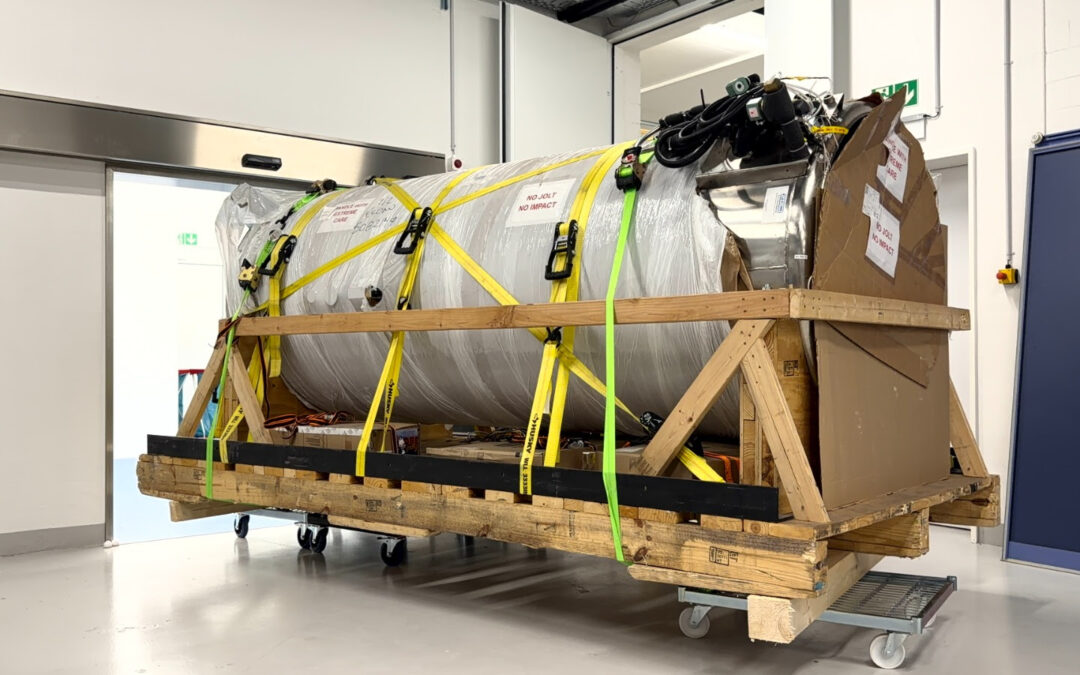
Today, September 7, 2026, at 7 PM CET (1 PM EST), Tomorrow.bio will be hosting a livestream about the world’s first whole-body ITS system.
ITS means “Intermediate Temperature Storage.” It’s a cryogenic storage system designed to keep a vitrified patient at roughly -140°C, rather than immersed in liquid nitrogen at -196°C, as is conventional.
After cryoprotectants turn wholw body tissues into a glass-like solid, cooling that enormous, complicated object another 50 degrees causes different tissues to contract at different rates. Mechanical stress can produce macroscopic fractures—literal cracks through organs, blood vessels, and potentially the brain. Cooling slowly helps, but does not necessarily eliminate them.
An ITS system therefore tries to hold the patient: cold enough to remain securely below the cryoprotectant’s glass-transition temperature, so molecular activity is effectively arrested; warm enough to avoid much of the additional contraction and thermal stress produced on the way down to −196°C; and at a carefully controlled, uniform temperature throughout the entire body.
The core attraction is fracture reduction. Fractures may not erase the microscopic information on either side of a crack, but they would make any eventual rewarming, reperfusion and repair enormously more difficult. A whole-body ITS system could therefore leave future medicine with a substantially less mechanically damaged patient.
ITS has been used before for specimens and for neuropatients. Alcor received a 14-neuropatient ITS dewar in 2008. What is new here is the scale. According to Tomorrow.bio, the unit delivered to the European Biostasis Foundation in Switzerland in August 2026 is the first human-sized ITS dewar possessed by a cryopreservation organization. That makes it an important engineering milestone rather than an entirely new scientific principle. Tomorrow.bio’s technical explanation and Brian Wowk’s history of ITS development provide informative background.
Note: ITS probably reduces fracturing; it has not been proven to eliminate it. Storing closer to the glass-transition temperature may also increase concerns about ice nucleation and long-term stability. The system is more complicated, holds less liquid nitrogen internally, may require more frequent refilling, and introduces sensors, controllers and electrical components that conventional immersion storage does not need. Ordinary liquid-nitrogen immersion is crude but extraordinarily passive and robust.
Most importantly, Tomorrow.bio says the new dewar is presently in commissioning and long-duration testing—not yet routine patient service. Nonetheless, it is potentially the largest improvement in the mechanics of whole-body cryonic storage in decades. Todaya promising full-scale engineering system is undergoing testing and validation. It not yet proof that fracture-free whole-body storage has been achieved.
It is proof, however, or Tomorrow.bio’s serious commitment to advancing the science and practice of cryonics. To learn more about the challenges, and Tomorrow.bio’s attempts to overcome them, see Tomorrow.bio’s R&D roadmap.
Submit your questions here.
Access the livestream here.
My experience with similar systems showed that the transition to this temperature actually took several weeks to stabilize. Conventional methods might seem faster, but the surface layer of material needs time to reach equilibrium.